What is an Autorrive Report? Know More Before You Choose Your Car
Explore the Autorrive Report: crash ratings, safety equipment, VIN details, recalls and EPA fuel estimates. See a real Honda Pilot example and shop confidently.
Published September 30, 2026
Watch the guide
What Is an Autorrive Report? Choose With Confidence
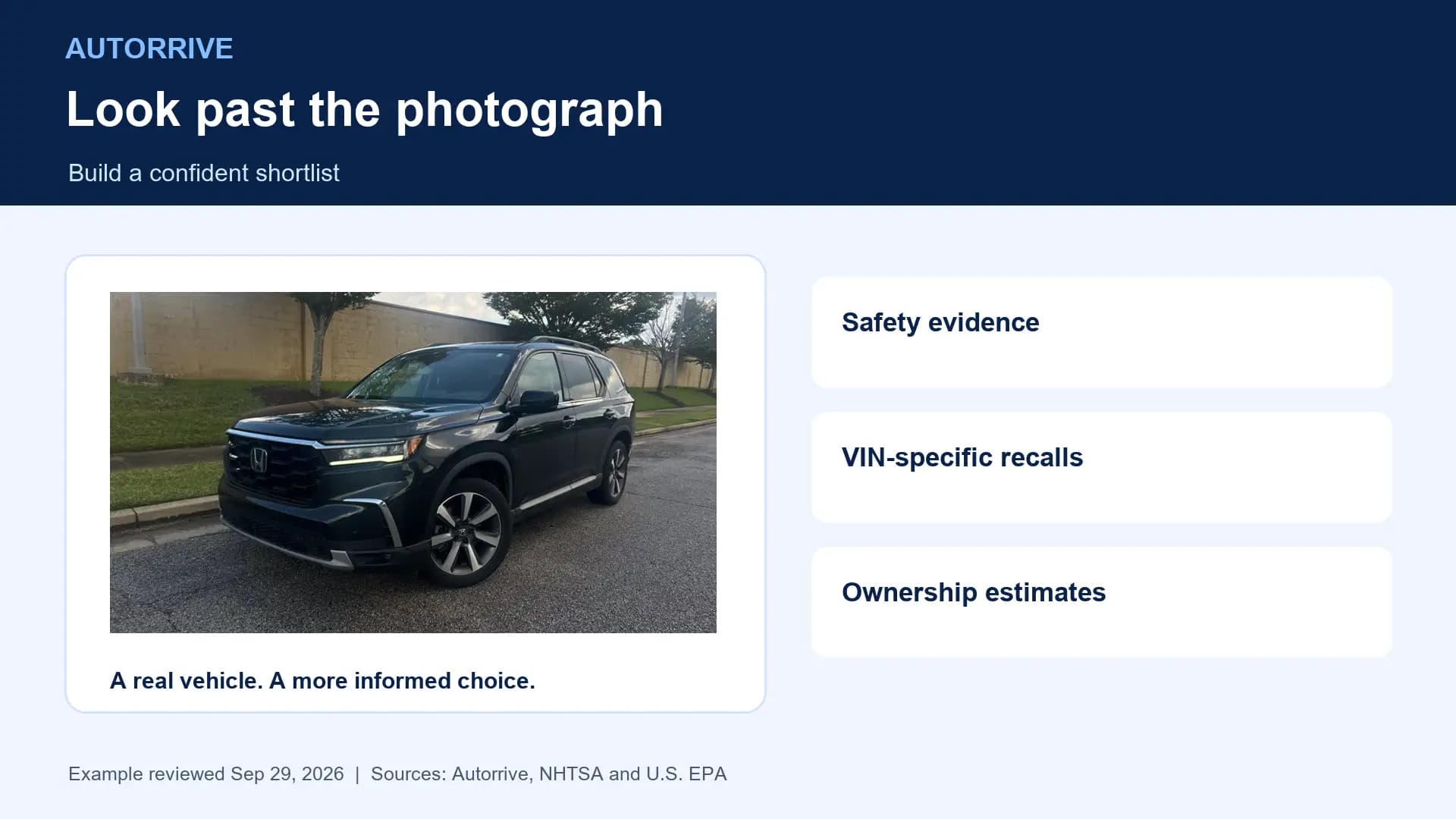
Two cars can look equally appealing in a photograph. The smarter shortlist starts when you understand the evidence behind the listing. The Autorrive Report brings safety, equipment, configuration and everyday ownership information into your car-shopping experience.
First, connect the report to the car you want. The stock number and selling dealer identify the inventory listing. The vehicle identification number identifies the vehicle. For our walkthrough, we reviewed a twenty twenty-five Honda Pilot Elite with all-wheel drive and a detailed Autorrive Report.
Here is the section worth opening first. This example earns five out of five overall stars from the National Highway Traffic Safety Administration. Autorrive labels the source and matching configuration, then lets you explore the crash-test evidence without leaving the shopping flow.
Five overall stars does not mean five stars in every test. Our example shows four for frontal crash protection, five for side crash protection, and four for rollover resistance. The detailed view also shows driver, passenger, side-barrier and pole results where available. You can understand the strengths behind the headline.
For overall and frontal stars, compare vehicles in the same class and within two hundred and fifty pounds of curb weight. These ratings describe a tested configuration, not this used vehicle’s accident history. The report keeps official stars distinct from any additional independent testing or Autorrive assessment.
Next, review safety equipment. Active systems can help an attentive driver recognize or respond to a developing hazard. Passive protection includes airbags and structural features. The labels matter: Yes means vehicle-identification-number reported; Standard comes from a manufacturer model guide; Optional means installation is unconfirmed. Open the explanations, then ask the dealer to demonstrate the features you value.
A crash rating and a recall check answer different questions. For this exact Pilot, the official recall lookup returned zero unrepaired recalls, with data refreshed September twenty-ninth, twenty twenty-six. That is a dated vehicle-specific result. It does not mean a recall can never be announced later. Check the vehicle identification number again near purchase.
Continue through specifications, dealer-listed features and factory information. The example identifies a three point five liter, six-cylinder engine and provides grouped interior, exterior, mechanical and entertainment equipment. Source labels distinguish manufacturer-reported vehicle details from listing features. Focus your test drive on passenger space, comfort and the equipment you will actually use.
The fuel section adds another practical comparison. This all-wheel-drive example shows nineteen miles per gallon in the city, twenty-five on the highway, and twenty-one combined, using regular gasoline. EPA-matched estimates help you plan, but your mileage, local fuel price and driving conditions determine your real costs.
Available investigations and manufacturer communications can help you ask informed questions about maintenance, repairs and updates. They are matched model information, not a diagnosis of this individual vehicle. A bulletin count is not a reliability score. The report preserves that context so useful evidence does not become an unsupported conclusion.
The benefit is a more confident next step. You can compare safety evidence, understand reported equipment, check dated recall information and plan everyday costs before contacting the dealer. Open the Autorrive Report, connect the details to your needs, and arrive ready to choose a car you are excited to drive.
A car listing can show a beautiful vehicle and an attractive price. The Autorrive Report helps you understand what you are actually comparing: crash-test results, reported safety equipment, vehicle specifications, factory configuration, fuel economy, and available recall and service information. It brings useful evidence into the shopping experience, so your next step can be a confident conversation about the right car.
The biggest benefit is context. You can look beyond a model name or a long equipment list, see how information was matched, and decide which details matter to your family, commute and budget. The report lives on the vehicle detail page. Open the Autorrive Safety Report to explore the safety evidence, then continue through the other available sections.
What is an Autorrive Report?
An Autorrive Report is Autorrive’s organized vehicle-information view within a car listing. Depending on the evidence available for that vehicle, it combines official VIN-decoded details, configuration-matched government ratings and estimates, manufacturer equipment information, dealer-listed features, and verified VIN-specific recall results. Source labels and dates help explain what each result actually describes.
That distinction is valuable. A crash rating belongs to a tested vehicle configuration. A VIN decode identifies information reported for a specific vehicle. A dealer feature list describes equipment offered in the listing. A model-year investigation is broader than a finding about the car in front of you. Bringing them together does not make them interchangeable; a useful report tells you which is which.
Use the report to build a smarter shortlist and prepare for a test drive. It is not an accident-history report, a mechanical inspection certificate, or a guarantee that every available feature is installed and operating. Its value comes from making meaningful evidence easier to find and understand while you choose a car.
A real example: a Honda Pilot with substantial report data
For this walkthrough, we reviewed an Autorrive listing for a 2025 Honda Pilot Elite with all-wheel drive, stock H28168A, VIN 5FNYG1H85SB099000. The example had detailed safety, equipment, specifications and EPA-matched fuel-economy information. Listing availability, mileage and price can change; the report values below are a dated example rather than a promise about all Pilots.
A quick look at the example report
Report area
Observed result
Why it matters
NHTSA overall rating
5 out of 5 stars
A strong starting point for reviewing crash-test evidence
Frontal / side / rollover
4 / 5 / 4 stars
Shows the differences a single overall number can hide
Fuel economy
19 city / 25 highway / 21 combined MPG
Helps compare vehicles for your driving routine
Engine and configuration
3.5-liter V6; AWD configuration
Helps confirm which vehicle and ratings you are considering
Exact-VIN recall lookup
0 unrepaired recalls; NHTSA data refreshed September 29, 2026
Provides a dated result for this VIN, not a model-wide assumption
The stock number identifies the selling dealer’s inventory unit. The VIN identifies the vehicle. Showing the stock number and selling dealer together at the top of the report makes it easier to keep the evidence connected to the listing you want to discuss.
The Autorrive Safety Report: the section worth opening first
Safety information can be easy to miss when shopping is dominated by photos, trim names and monthly payments. Autorrive puts a dedicated safety view directly into the vehicle page. The benefit is substantial: you can review crash protection, reported crash-avoidance equipment and the evidence behind them before you decide which cars deserve a closer look.
Start with the source label. In our example, the five-star overall result is explicitly an NHTSA rating. It is not presented as an invented Autorrive crash-test score. The report identifies the matching year, model and drivetrain, then lets you expand the details. That makes the rating useful without asking you to treat every vehicle wearing the same badge as identical.
Overall stars are a starting point, not the whole story
NHTSA’s overall rating combines information from frontal, side and rollover testing. Five stars is the highest rating on that scale. Our Pilot example shows five overall stars, but the expanded summary shows four for frontal crash protection, five for side crash protection, and four for rollover resistance. Those results are consistent with a strong overall rating while still giving you a more complete picture.
This is why the expandable view matters. If two cars both have five overall stars, the individual tests can give you useful differences to discuss. For overall and frontal ratings, make comparisons within the same vehicle class and within 250 pounds of curb weight, as NHTSA directs. A heavier SUV and a much lighter sedan are not an appropriate head-to-head comparison using those stars.
Frontal, side and rollover results explain different risks
The frontal section looks at protection in the tested frontal-impact scenario. Where available, the details separate driver and front-passenger results. The example shows four stars for each. The side section can show barrier, pole and seating-position results; this example displays five-star results across the listed side tests. Those details let you see the evidence supporting the summary rather than stopping at a badge.
Rollover resistance addresses a different question from occupant protection in a side impact. The Pilot example displays four stars and a 14.3% rollover possibility in NHTSA’s defined scenario. That percentage is a test-based measure, not a prediction that this car has a 14.3% chance of rolling over during normal driving. Read it with the test context and remember that driving conditions and driver behavior matter.
Active safety and passive protection: two kinds of help
Active safety equipment helps a driver recognize or respond to a developing situation. Depending on the vehicle, the report can identify automatic emergency braking, forward-collision warning, lane-departure warning, lane-keeping assistance, rear cross-traffic alert, stability control and other systems. Passive protection addresses what helps protect occupants in a crash, including airbags and structural features. Looking at both is more useful than treating one long feature list as a safety verdict.
In the Pilot report, automatic emergency braking, forward-collision warning and lane-keeping assistance are marked Yes, while blind-spot warning is marked Optional. The labels explain the strength of the equipment evidence. Yes means VIN reported; Standard comes from the manufacturer’s model guide; Optional means installation is unconfirmed. Other labels, such as Partial or Dealer reported, preserve information without overstating it.
Tap the information controls for a feature explanation, then ask the dealer to demonstrate the equipment that matters to you. Driver assistance requires an attentive driver. Equipment presence also does not establish crash performance: an airbag or braking-system label is not a replacement for the crash-test results.
Why showing the evidence is such a useful shopping advantage
The report brings together information that otherwise requires several separate searches. You can see the matching configuration, expand the individual crash tests, review equipment labels and check the source dates in the same shopping flow. For a family comparing passenger space and daily comfort, this puts an equally important question—how the vehicle performs in the available safety evidence—within reach.
The report also separates NHTSA stars from additional independent testing and any Autorrive assessment. Our example does not include a verified independent IIHS assessment or an Autorrive composite score. That transparency is a benefit: missing evidence stays missing rather than becoming an unsupported award. Available sections and results differ by vehicle.
Recall information: a result for the VIN you are buying
A recall check answers a different question from a crash rating. A highly rated vehicle can still have an unrepaired recall. The useful result is a current check for the exact VIN, with a source and date—not a general statement that a model has no recalls.
For this example, NHTSA’s official VIN lookup returned 0 unrepaired recalls associated with VIN 5FNYG1H85SB099000. The result showed recall data refreshed September 29, 2026, and was checked that evening Central time. That is the factual basis for the no-open-recalls example. It does not mean the vehicle has never been recalled or can never be recalled later.
A zero result has boundaries. Completed recall repairs do not appear as unrepaired recalls, newly announced recalls may not yet include every affected VIN, and the lookup does not cover every older or non-safety campaign. Check the VIN again near purchase and ask the dealer about the current result and completed repair records. If verified VIN-specific data is unavailable, the report must not turn that gap into a zero.
Explore the inventory
Vehicles related to your search
Explore vehicles similar to your recent searches, or popular models when you are just getting started.
Investigations and manufacturer communications: useful context
The report may also show NHTSA investigations and manufacturer communications matched to the year, make and model. Communications can include service bulletins, repair instructions, campaigns, warranty extensions and software updates. They help you ask more informed questions about maintenance, completed work and applicable updates.
These records are not a diagnosis of the individual listing. The number of communications is not a reliability score or a problem rate, and an investigation is not the same thing as an unrepaired recall. Keep the model-level label in view and discuss relevant records with the dealer in the context of the actual car.
Specifications and features: confirm what fits your life
The specifications section helps translate a listing into practical details. Official VIN-decoded facts and dealer-provided information are labeled. The Pilot example includes a reported 285-horsepower engine, curb weight and gross vehicle weight-rating class, followed by the dealer’s engine description and grouped equipment lists.
Interior, exterior, mechanical and entertainment features can help you narrow a shortlist around daily needs: passenger comfort, heated or ventilated seats, smartphone connectivity, third-row access and other equipment. Compare the features you will use, then confirm them on the actual vehicle. A reported equipment list is a useful starting point for a test drive, not a reason to skip checking how a feature works.
Factory configuration and equipment: connect the VIN to the car
The factory-information section uses NHTSA vPIC VIN-decoded data. Depending on what the manufacturer reported, it can identify the vehicle type, doors, engine configuration, engine manufacturer, engine model, cooling system, valve train and manufacturing location. Blank facts are omitted rather than invented.
Our example identifies a 3.5-liter, six-cylinder V-shaped engine and an Alabama manufacturing location. The practical benefit is confidence in the configuration you are considering. Engine, drivetrain and body details help keep fuel-economy and safety information connected to an appropriate match instead of a broad model-name assumption.
Fuel economy, emissions and ownership estimates: plan beyond the price
The EPA-matched section puts everyday ownership information alongside the vehicle. Our Pilot example shows 19 MPG city, 25 MPG highway and 21 MPG combined, using regular gasoline. It also shows fuel used per 100 miles, estimated fuel costs, emissions measures and available efficiency-related equipment.
The report’s example fuel estimate is $2,950 per year, or about $246 per month, from the displayed EPA data. These are standardized estimates, not a forecast of your fuel bill. Your mileage, fuel prices, driving style and conditions change the result. The useful comparison is to apply the same assumptions across the cars on your shortlist and then adapt the budget to your routine.
Fuel-economy, greenhouse-gas and tailpipe-emissions figures address different questions. A score out of ten in this section is not a crash-safety score. Match the label to the number so an ownership comparison remains clear. The report identifies the EPA configuration and retrieval date, helping you judge the context behind the estimate.
How to use the report before your next test drive
Connect the report to the stock number, VIN and selling dealer for the listing you want.
Open the Safety Report and read the overall rating, individual tests, configuration and source date.
Review active and passive safety features; identify equipment you want the dealer to demonstrate.
Check the dated VIN-specific recall result and ask about any relevant repair records or model-level service information.
Compare specifications, seating and comfort features with your real passengers and cargo.
Use the EPA-matched fuel figures to build a monthly budget, then adjust for your driving routine.
The payoff is a better conversation. Instead of asking only whether a car is still available, you can ask about the precise equipment, configuration and records that make it a good fit. You arrive with a focused shortlist and useful questions, ready to choose a vehicle you can feel good about driving.
Common questions about the Autorrive Report
Is the Autorrive Report available on the vehicle page?
Yes. Look for the Autorrive Report within the listing and expand the Autorrive Safety Report. The sections shown depend on the data available for that vehicle.
Does five stars mean every individual test earned five stars?
No. The example has five NHTSA overall stars with four frontal, five side and four rollover stars. Open the detailed results to understand the combination.
Does the report prove a used car has never had an accident?
No. Crash-test results describe a tested configuration, not the individual car’s accident history or current physical condition.
Does Optional mean the car definitely has that safety feature?
No. Optional identifies equipment whose installation is unconfirmed in the report. Confirm it with the dealer on the exact vehicle.
What does no open recalls mean?
It means the dated, verified lookup did not report an unrepaired recall for that VIN. It is not a lifetime guarantee or a statement that no recall has ever existed.
Will every report contain the same information?
No. Available official data, matching confidence and manufacturer reporting vary. The report labels its evidence and avoids inventing missing facts.
Know more. Choose with confidence.
The Autorrive Report turns useful vehicle evidence into a practical shopping advantage. Open it before your next test drive, give the safety section the attention it deserves, and connect what you learn to your family, driving routine and budget. A car that looks right is a good beginning; understanding why it fits makes choosing it more rewarding.
Explore the inventory
Vehicles related to your search
Explore vehicles similar to your recent searches, or popular models when you are just getting started.